The Midnight Ride of Paul Revere: A Comprehensive Overview
Finding a “Paul Revere’s Ride” PDF online presents options via CommonLit, the Poetry Foundation, and Academy of American Poets, offering educational resources.
Legitimate sources for PDF downloads include established educational platforms, ensuring accurate text and avoiding copyright infringements, while providing valuable insights.
Potential risks of downloading PDFs from unverified sources involve malware, inaccurate content, and legal issues; prioritize trusted websites for safe access.
Historical Context of the Ride
The events preceding Paul Revere’s ride unfolded amidst escalating tensions between Great Britain and its American colonies in 1775. British troops occupied Boston, and colonial militias were preparing for potential conflict. The Massachusetts Provincial Congress, a governing body formed by colonists, had been stockpiling arms and ammunition in Concord.
British General Thomas Gage received intelligence about these colonial preparations and planned a raid to seize the military supplies. The secrecy surrounding this operation was paramount, and colonial spies, including Revere, worked tirelessly to gather information about British movements. The need for swift communication became critical as the date of the British march approached.
Revere’s role was part of a larger network of riders tasked with alerting the countryside of the British advance. The availability of “Paul Revere’s Ride” as a PDF through resources like CommonLit allows modern audiences to study the historical backdrop, understanding the urgency and significance of the events that unfolded on that fateful night. The poem, while romanticized, is rooted in a very real and volatile political climate.
The Poem’s Influence on Historical Perception
Henry Wadsworth Longfellow’s “Paul Revere’s Ride,” readily available as a PDF through platforms like CommonLit and the Academy of American Poets, dramatically shaped public understanding of the event. Before the poem’s publication in 1860, Revere was a relatively obscure figure in Revolutionary War lore.
Longfellow’s narrative transformed Revere into a heroic symbol of American courage and patriotism. The poem’s vivid imagery and rhythmic verse captured the nation’s imagination, solidifying Revere’s place in the national consciousness. However, this romanticized portrayal also overshadowed the contributions of other riders, like William Dawes and Samuel Prescott.
The poem’s influence extends beyond historical accuracy; it created a powerful myth that continues to resonate today. Accessing the poem as a PDF allows for critical analysis of its artistic license and its impact on how Americans perceive this pivotal moment in their history, prompting discussions about historical truth versus poetic interpretation.
Henry Wadsworth Longfellow and the Poem
Henry Wadsworth Longfellow, a prominent 19th-century American poet, penned “Paul Revere’s Ride,” a work now widely accessible as a PDF via resources like the Poetry Foundation and CommonLit. Longfellow wasn’t a historian, but a master storyteller who sought to inspire patriotism during a period of national division.
His poem wasn’t intended as a strictly factual account, but rather a stirring narrative designed to evoke emotion and celebrate American ideals. Longfellow drew inspiration from existing historical accounts, but significantly embellished the story for dramatic effect. The PDF version allows close examination of his poetic choices.
Longfellow’s revisions, as evidenced in the Isabella Stewart Gardner Museum’s autograph manuscript PDF, demonstrate his deliberate crafting of urgency and completion. He prioritized creating a memorable and impactful poem over strict adherence to historical detail, resulting in a lasting cultural legacy.
Publication and Initial Reception of “Paul Revere’s Ride”
“Paul Revere’s Ride” first appeared in The Atlantic Monthly in April 1860, quickly gaining popularity. Accessible today as a PDF through platforms like CommonLit, the poem resonated with a nation on the brink of the Civil War, fostering a sense of shared history and patriotic fervor.
Initial reception was overwhelmingly positive, with readers captivated by Longfellow’s vivid imagery and heroic portrayal of Revere. The poem’s accessibility and memorable rhythm contributed to its rapid spread, becoming a staple in American classrooms and households. Finding a PDF copy allows modern readers to experience this initial impact.
While some historians later critiqued its historical inaccuracies, the poem’s cultural influence remained strong. The readily available PDF format ensures continued engagement with Longfellow’s work, preserving its place in American literary and historical consciousness.
Analyzing Key Stanzas and Imagery
The opening lines, “Listen, my children, and you shall hear,” immediately establish a storytelling tone, inviting readers into a historical narrative easily accessible via a PDF version of the poem. Longfellow’s use of vivid imagery, like Revere being “booted and spurred, with a heavy stride,” paints a dynamic picture of urgency.
The description of Revere’s preparation emphasizes his readiness and determination. The significance of the lantern signals – “One if by land, and two if by sea” – is a pivotal moment, readily highlighted when studying a PDF copy. This imagery creates suspense and foreshadows the British advance.
Analyzing these stanzas reveals Longfellow’s skill in crafting a compelling narrative. Accessing the poem as a PDF facilitates close reading and detailed examination of its poetic devices, enhancing understanding of its enduring appeal and historical impact.
The Opening Lines: “Listen, My Children…”
The iconic opening, “Listen, my children, and you shall hear,” immediately establishes a captivating, oral storytelling tradition, readily experienced when reading a PDF of Longfellow’s poem. This invites a multigenerational connection to history, framing the narrative as a cherished tale passed down through time.
These lines function as a direct address, creating intimacy between the poet and the audience. A PDF format allows for focused annotation of this crucial opening, highlighting its impact on setting the poem’s tone and purpose. It’s a deliberate choice to engage the reader emotionally.
The simplicity of the language belies the poem’s complex themes. Accessing the text as a PDF enables easy reference and analysis of these initial verses, revealing their foundational role in shaping the reader’s perception of Paul Revere’s ride and its significance.
The Description of Revere’s Preparation
Longfellow meticulously details Revere’s readiness, emphasizing his focused determination. A PDF version of “Paul Revere’s Ride” allows for close reading of phrases like “Booted and spurred, with a heavy stride,” vividly portraying his physical and mental preparation for the urgent mission. This imagery is crucial to the poem’s dramatic effect.
The poet highlights Revere’s impatience, “impatient to mount and ride,” underscoring the gravity of the situation and the necessity of swift action. Studying this section within a PDF format facilitates a deeper understanding of Revere’s character and the poem’s pacing.
This preparation isn’t merely physical; it’s a symbolic representation of colonial resolve. Accessing the poem as a PDF enables easy comparison of these descriptive lines with historical accounts, fostering a nuanced perspective on Revere’s role and the impending conflict.
The Significance of the Lantern Signals
The poem’s depiction of the lantern signals – “One if by land, and two if by sea” – is iconic, yet historically debated. A PDF of “Paul Revere’s Ride” allows for repeated examination of these lines, revealing their poetic power and the ambiguity surrounding their actual implementation.
Longfellow’s version simplifies the complex communication network, focusing on a single, dramatic signal. Accessing the poem in PDF format alongside historical analyses exposes this simplification, prompting critical thinking about the poem’s accuracy.
The signals represent a crucial moment of warning, alerting colonists to the British advance. Studying the poem as a PDF encourages exploration of the symbolism embedded within these visual cues, and their impact on the unfolding events of that night. The poem’s enduring legacy relies heavily on this imagery.
The Real Story Behind the Ride: Separating Fact from Fiction
A PDF version of Longfellow’s “Paul Revere’s Ride” serves as a starting point for dissecting historical inaccuracies. The poem dramatically focuses on Revere, omitting key figures like William Dawes and Samuel Prescott, a detail readily apparent when comparing the poem to historical accounts available online in PDF format.
The poem’s portrayal of Revere reaching Concord is also a fabrication. Historical PDF documents reveal he was intercepted before reaching his destination. Examining these sources alongside the poem highlights Longfellow’s artistic license.
Furthermore, the poem misrepresents the purpose of the Old North Church lanterns. Accessing scholarly articles as PDFs clarifies the signals were pre-arranged for local observation, not a direct instruction to Revere. Understanding these discrepancies is crucial for a nuanced understanding of the event.
The Role of William Dawes and Samuel Prescott
While Longfellow’s poem immortalizes Paul Revere, a comprehensive understanding, often found in detailed historical PDFs, reveals the crucial contributions of William Dawes and Samuel Prescott. Dawes, riding a different route, alerted colonists south of Boston, a fact often overshadowed by Revere’s fame.
Prescott, joining Revere later, continued the warning after Revere’s capture. Examining primary source documents available as PDFs demonstrates Prescott successfully reached Concord, completing the mission Revere could not. Their combined efforts were vital to the colonial response.

Many historical analyses, accessible in PDF format, critique Longfellow’s singular focus on Revere, arguing it diminishes the bravery and importance of Dawes and Prescott. Recognizing their roles provides a more accurate and complete picture of the events of that night.
The Actual Signals in the Old North Church
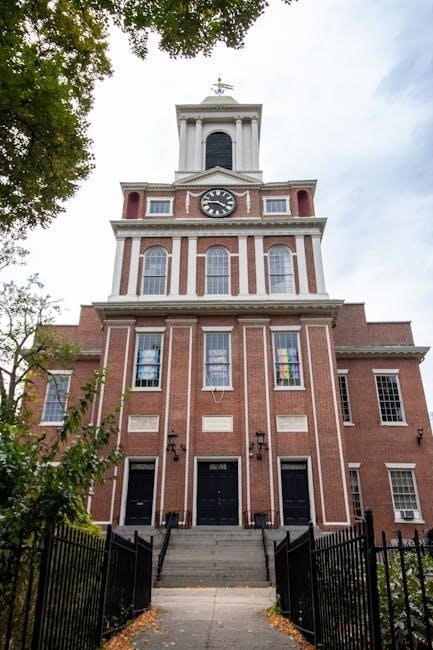
Detailed historical accounts, often available as comprehensive PDF documents, clarify the true purpose of the lanterns hung in the Old North Church. Contrary to the poem’s depiction, the signals weren’t specifically for Revere, but rather communicated the British route to Charlestown patriots.
One lantern signified the British were traveling “by sea” (across the Charles River), while two indicated they were moving “by land” (towards Cambridge). These signals, documented in various PDF resources, were a pre-arranged system for local militia preparedness.
Scholarly PDF analyses reveal Revere already had knowledge of the British plan and didn’t rely solely on the lantern signals. The poem romanticizes this aspect, creating a narrative divergence from historical fact. Understanding the original intent provides a nuanced perspective.
Revere’s Mission and Destination: Beyond Concord
Many PDF resources detailing the ride clarify Revere’s primary objective wasn’t solely to warn Concord. His mission extended to alerting Lexington and, crucially, Samuel Adams and John Hancock, who were staying in Lexington at the time. This is a key detail often glossed over.
PDF analyses of historical records demonstrate Revere was tasked with delivering intelligence about the British movements to these key revolutionary figures. Concord was a subsequent destination, part of a broader warning network.
The poem, as explored in various academic PDFs, focuses heavily on Concord, simplifying the complexity of Revere’s journey; He didn’t reach Concord at 2:00 a.m., as Longfellow suggests; he was intercepted before arriving. Understanding the full scope of his mission, accessible through detailed PDF documentation, is vital.

The British Advance and Colonial Response
PDF documents detailing the events leading up to the Battles of Lexington and Concord reveal the British advance was initiated to seize colonial arms and ammunition stockpiled in Concord. This intelligence spurred the need for Revere’s warning ride, as outlined in numerous online PDF resources.
The colonial response, triggered by Revere and others, involved mobilizing the local militia – the Minutemen – to prepare for a potential confrontation. PDF analyses of historical accounts emphasize the speed and effectiveness of this mobilization.
Accessing primary source materials via PDF format allows for a deeper understanding of the colonial reaction. The initial skirmish at Lexington, sparked by the British arrival, quickly escalated into a full-blown battle, marking the start of the Revolutionary War. Educational PDFs, like those from CommonLit, illustrate this pivotal moment.
Paul Revere’s Earlier Life and Activities
Before his famed ride, Paul Revere was a prominent Boston silversmith and engraver, details readily available in biographical PDF documents. These resources showcase his established trade and community standing, crucial context often overlooked.
PDF archives reveal Revere’s active involvement in colonial politics, including participation in the Sons of Liberty and the Boston Tea Party. His pre-ride activities demonstrate a commitment to the Patriot cause, shaping his willingness to risk alerting the colonists.
Numerous online PDFs highlight Revere’s skills as a messenger and organizer within the colonial network. He wasn’t simply a rider, but a key figure in communication and resistance. Studying these PDF resources provides a comprehensive view of Revere beyond the popularized poem, revealing a dedicated activist and craftsman.
Revere as a Silversmith and Engraver
Paul Revere’s primary profession was as a highly skilled silversmith and engraver, a fact extensively documented in accessible PDF biographies. These PDF resources showcase his intricate craftsmanship, detailing examples of his silverware, teapots, and other metalwork.
Beyond functional items, Revere created politically charged engravings, like the famous depiction of the Boston Massacre, readily available in digital PDF format. These works demonstrate his artistic talent and his commitment to the Patriot cause, using art as a form of protest.
Exploring PDF collections of his work reveals Revere’s economic independence and social standing within colonial Boston. His successful business allowed him the freedom and resources to participate in revolutionary activities, making his silversmithing integral to his later role. These PDFs offer a tangible connection to his life before the ride.
Revere’s Involvement in the Boston Tea Party

While details are somewhat obscured by time, historical accounts – often found within comprehensive PDF documents – confirm Paul Revere’s active participation in the Boston Tea Party. He wasn’t a leading organizer, but was demonstrably involved in the pivotal act of defiance against British taxation.
PDF biographies detail how Revere, as a member of the Sons of Liberty, likely assisted in disguising participants and transporting the tea chests to Griffin’s Wharf. His skills as a messenger and engraver were valuable assets to the cause, as highlighted in accessible PDF resources.
The Boston Tea Party solidified Revere’s commitment to colonial resistance, setting the stage for his later actions. Examining PDF analyses of the event reveals how it escalated tensions and propelled the colonies toward revolution. These PDFs contextualize his later ride as a natural progression of his patriotic fervor.
The Impact of the Ride on the Revolutionary War
Though often romanticized, Paul Revere’s ride – detailed in readily available PDF versions of Longfellow’s poem and historical analyses – played a crucial, albeit limited, role in the Revolutionary War’s opening stages. It wasn’t a singular event that sparked the conflict, but a vital warning system.
PDF documents emphasize that Revere’s alert allowed the Massachusetts militia to prepare for the British advance on Concord, enabling a more organized resistance. While the British did seize colonial arms, the Minutemen were ready, initiating the Battles of Lexington and Concord.
Accessing PDF resources from sources like CommonLit reveals how the ride became a powerful symbol of colonial defiance. Longfellow’s poem, often found as a PDF, further cemented Revere’s legacy, inspiring patriotic sentiment and bolstering the revolutionary cause. The ride’s impact resonated throughout the war.
The Gardner Museum Autograph Manuscript
The Isabella Stewart Gardner Museum holds a significant piece of literary history: an autograph manuscript of Henry Wadsworth Longfellow’s “Paul Revere’s Ride.” This PDF-accessible artifact, page 9 specifically, showcases Longfellow’s meticulous revisions, revealing his crafting process.
Analysis, often available in scholarly PDFs, highlights how Longfellow amplified the urgency of Revere’s message through layered descriptions of “darkness and peril.” He strategically inserted lines like “The people will waken and listen to hear,” creating a cyclical effect, echoing the poem’s opening.
Researchers utilizing digital PDF copies can study Longfellow’s handwriting and annotations, gaining insight into his poetic intentions. The manuscript demonstrates his commitment to creating a compelling narrative, even while taking liberties with historical accuracy, as detailed in comparative PDF analyses.
Longfellow’s Revisions and Their Impact
Examining PDF versions of Longfellow’s manuscript reveals substantial revisions to “Paul Revere’s Ride,” significantly shaping its enduring impact. The poet amplified dramatic elements, prioritizing narrative flow over strict historical fidelity, a point often discussed in critical PDF analyses.
His additions, like piling up descriptions of emergencies, heightened the sense of urgency surrounding Revere’s mission. These changes, readily visible in digitized PDFs of the Gardner Museum manuscript, contributed to the poem’s memorability and emotional resonance.
Scholarly PDF resources demonstrate how Longfellow’s alterations transformed a relatively minor historical event into a powerful symbol of American courage and resistance. The poem’s widespread cultural influence, easily traced through online PDF archives, stems directly from these deliberate artistic choices.
Educational Resources: CommonLit and Poetry Foundation
CommonLit provides a comprehensive PDF resource for educators, offering “Paul Revere’s Ride” alongside instructional materials, benchmark assessments, and formative data tools. This platform facilitates in-depth analysis of Longfellow’s poem, supporting literacy instruction and critical thinking skills, readily available as a downloadable PDF.
The Poetry Foundation’s website features the complete text of the poem, often accessible as a PDF, alongside biographical information about Longfellow and insightful critical essays. Students can explore the poem’s themes and historical context through these readily available resources.
Both platforms offer free access to high-quality educational materials, making “Paul Revere’s Ride” an accessible and engaging topic for students of all levels. These PDF-supported resources enhance understanding and appreciation of this iconic American poem.
“Paul Revere’s Ride” in American Culture
Longfellow’s poem has deeply permeated American culture, shaping the popular understanding of the Revolutionary War era. The image of Paul Revere’s midnight ride is instantly recognizable, frequently appearing in textbooks, historical fiction, and artistic representations. Access to the poem, often through readily available PDF versions online, ensures its continued relevance.
The poem’s narrative has become a symbol of American courage, vigilance, and the fight for liberty. It’s often invoked in patriotic contexts, reinforcing national identity and historical memory. Finding a “Paul Revere’s Ride” PDF allows for easy access to this cultural touchstone.
Despite historical inaccuracies, the poem’s enduring power lies in its evocative imagery and compelling storytelling. Its accessibility, particularly through digital formats like PDFs, guarantees its continued influence on generations of Americans.
Modern Interpretations and Critiques of the Poem
Contemporary analysis often critiques Longfellow’s “Paul Revere’s Ride” for its historical liberties and romanticized portrayal of events. Scholars point out the poem minimizes the contributions of other riders, like William Dawes and Samuel Prescott, focusing almost exclusively on Revere. Accessing a “Paul Revere’s Ride” PDF facilitates comparative study with factual accounts.
Furthermore, the poem has been examined through a modern lens, questioning its nationalist undertones and simplified narrative. While celebrated for its poetic qualities, it’s recognized as a constructed narrative rather than a precise historical record. A PDF version allows for close textual analysis.
Despite these critiques, the poem remains a significant cultural artifact, prompting ongoing discussions about history, memory, and the power of storytelling. The availability of a digital PDF ensures continued engagement with this complex work.
Finding a “Paul Revere’s Ride” PDF Online
Locating a “Paul Revere’s Ride” PDF is readily achievable through several reputable online sources. CommonLit offers a free, accessible version alongside comprehensive educational resources, including lesson plans and assessments, ideal for classroom use. The Academy of American Poets website also provides the full text, often available for download or viewing as a PDF.
Additionally, the Poetry Foundation’s digital archive frequently hosts classic poems like Longfellow’s, potentially in PDF format. A simple web search using keywords like “Paul Revere’s Ride PDF download” will yield numerous results, but caution is advised.
Always prioritize established educational platforms and literary organizations to ensure the authenticity and quality of the PDF document, avoiding potentially unreliable or copyright-infringing sources.
Legitimate Sources for PDF Downloads
When seeking a “Paul Revere’s Ride” PDF, prioritizing legitimate sources is crucial for accuracy and safety. CommonLit stands out as a highly reliable option, offering a free PDF alongside robust literacy instruction materials, designed for educational purposes.

The Academy of American Poets website provides access to the poem, often available for download or viewing in a digital format, ensuring an authoritative text. Similarly, the Poetry Foundation’s extensive online archive frequently includes classic poems like Longfellow’s, potentially as a downloadable PDF.
These organizations guarantee copyright compliance and offer high-quality, verified content. Utilizing these platforms minimizes the risk of encountering inaccurate versions or malware, providing a secure and trustworthy experience when accessing this iconic poem in PDF format.
Potential Risks of Downloading PDFs from Unverified Sources
Downloading a “Paul Revere’s Ride” PDF from unverified websites carries significant risks. These sources often host malware, including viruses and spyware, which can compromise your device and personal information. The content itself may be inaccurate, containing errors or altered text, distorting Longfellow’s original work.
Furthermore, downloading from unauthorized sites can contribute to copyright infringement, supporting illegal distribution of copyrighted material. Such websites frequently lack security protocols, increasing the likelihood of encountering phishing scams or malicious redirects.
Protecting yourself requires vigilance. Always prioritize reputable educational platforms like CommonLit or established literary organizations like the Poetry Foundation. Avoid obscure websites offering free downloads, and ensure your antivirus software is up-to-date before accessing any PDF file from an unknown source.